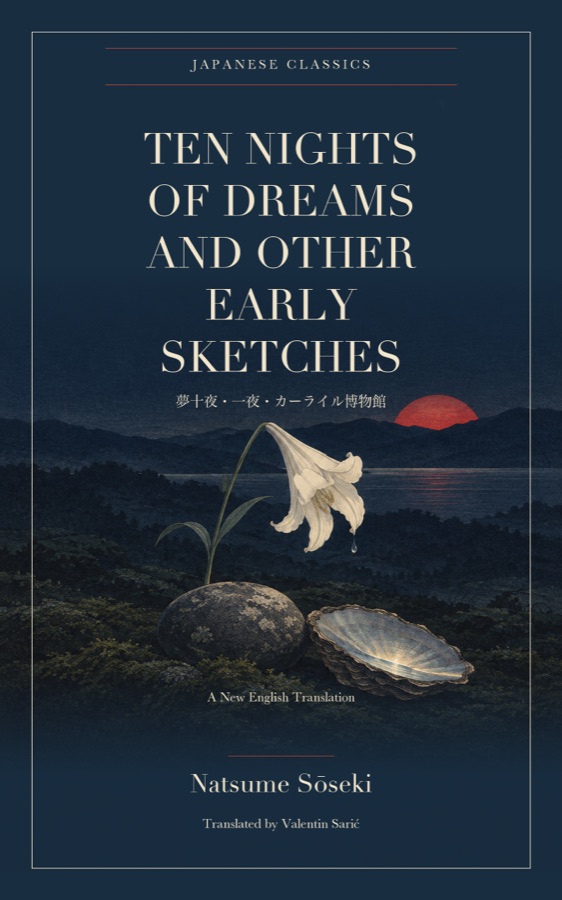
Ten Nights of Dreams and Other Early Sketches
A woman on her deathbed tells the man beside her to bury her and wait a hundred years. A samurai sits with a dagger beside him and an unanswerable Zen question before him. A sculptor at a temple gate digs gods out of wood, a barbershop mirror shows less and more than it should, and a great ship carries its passenger toward a place no one names. These are some of the ten dreams of Ten Nights of Dreams, the best-known short work of Natsume Sōseki (1867–1916), here with two quieter companions.
In A Night, a bearded man, a round-faced man, and a woman pass a rainy early-summer evening in an eight-mat room, trading half-lines of poetry, hearing a cuckoo for the first time, and watching two ants cross the tatami. In The Carlyle Museum, a Japanese student in London rings the bell at the house of Thomas Carlyle in Chelsea and follows a tireless guide up four floors to the attic study Carlyle built to escape the noise of the world.
Each work is translated complete and unabridged from the Japanese, with 86 brief endnotes, a translator's note, and source information. The dreams are strange without being cold, and the two sketches are witty and watchful.