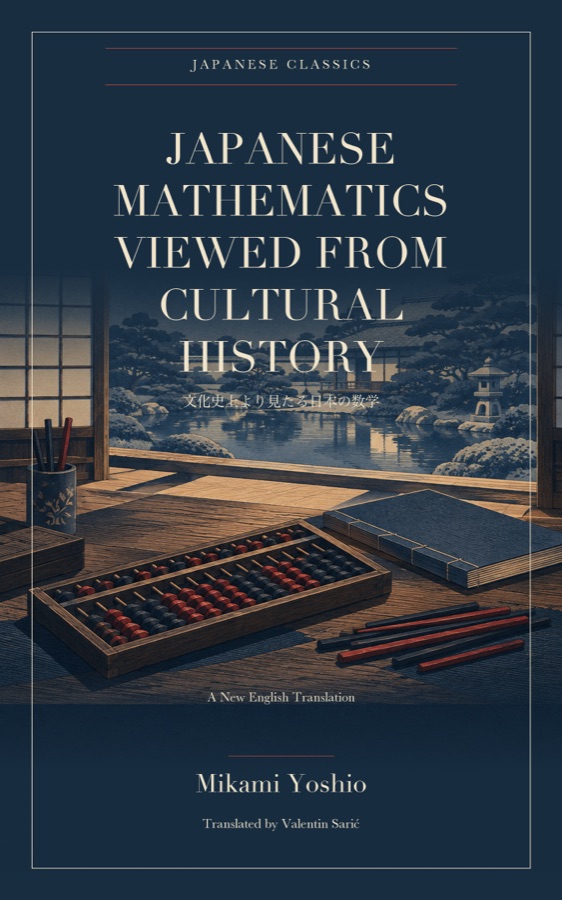
Japanese Mathematics Viewed from Cultural History
Japanese mathematics developed through schools, practical occupations, scholarly networks, and an enduring fascination with difficult problems. In this wide-ranging essay, Mikami Yoshio asks what that development reveals about the culture around it.
His account follows mathematical learning from its Chinese antecedents through the flourishing of wasan in the Tokugawa period and the encounter with Western science. Along the way appear abacuses and counting rods, mathematical books and challenge problems, samurai and merchants, astronomy and surveying, shrine offerings and private schools. Mikami connects these practices with literature, education, social status, and the habits of scholarly life, arguing that mathematics belongs within the history of culture as a whole.
First published in 1922, Japanese Mathematics Viewed from Cultural History presents both a rich historical inquiry and the distinctive judgments of its era. This complete new English translation retains all thirty-two numbered sections, with concise notes explaining historical terminology, names, and textual uncertainties. AI-assisted translation, prepared and edited by Valentin Sarić.