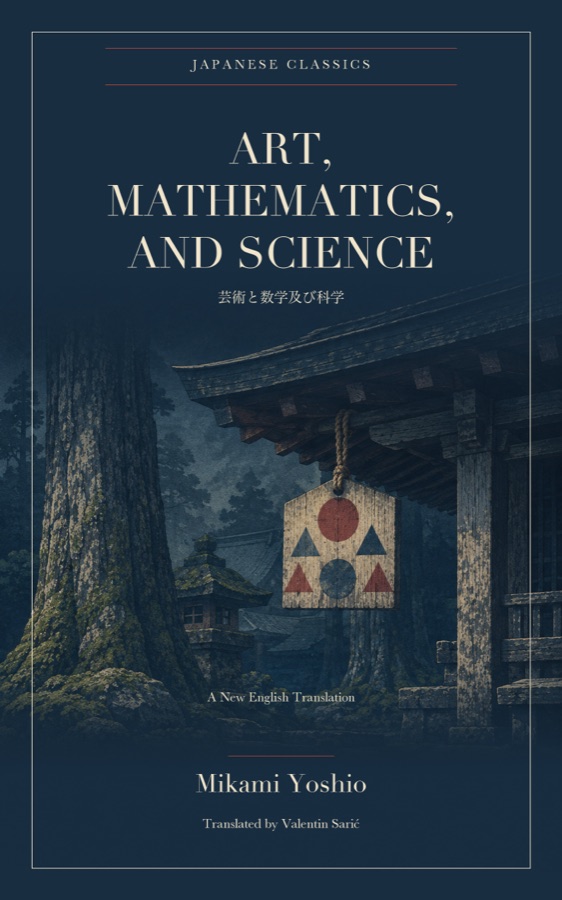
Art, Mathematics, and Science
Can the same culture excel in both art and science? Historian of mathematics Mikami Yoshio begins with an unexpected answer: Japanese mathematicians wrote poetry, illustrated their textbooks, and dedicated colorful mathematical problems at shrines and temples.
From these surviving votive tablets, he turns to thatched houses, family crests, Buddhist sculpture, and the columns of Hōryūji. His discussion then travels beyond Japan to Omar Khayyam, Leonardo da Vinci, Albrecht Dürer, and Christopher Wren, exploring how artistic skill and mathematical thought have met in individual lives and national traditions.
First published in 1929, the essay captures an ambitious moment in Japanese cultural history. Mikami argues that artistic accomplishment prepares the ground for scientific achievement, while acknowledging the familiar complaint that mathematical habits can make poetry overly argumentative.