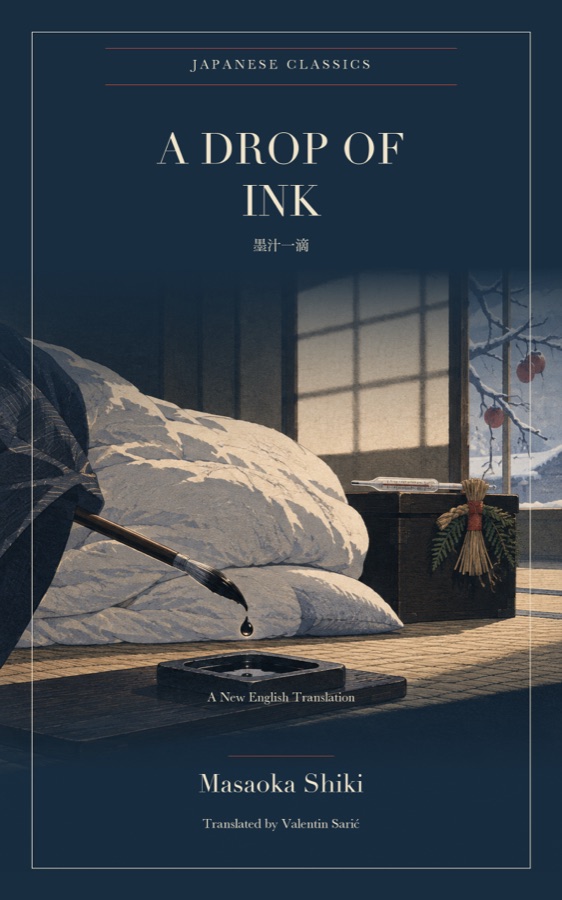
A Drop of Ink
In January 1901 Masaoka Shiki, the poet who remade haiku and tanka for modern Japan, could no longer leave his bed. Spinal tuberculosis had him pinned in a small room in Negishi, Tokyo. So he began to write for the newspaper Nihon a few lines a day: a single drop of ink.
For six months the drops kept coming. A New Year wreath tied to a thermometer. The pain of the morning bandage, and Guan Yu reading a book while the surgeon cut. A phonograph carried into the sickroom. A list of ten discontents. Chinese characters everyone writes wrong. A forgotten Okayama poet, Hiraga Motoyoshi, hailed as the only true heir of the Man'yōshū. A sleepless night logged hour by hour. An argument with King Enma, judge of the dead. Memories of failed school examinations, and a farewell to the painter Nakamura Fusetsu as he set out for the West.
Funny, combative, learned and frank about pain, A Drop of Ink is one of the great sickbed books of Japanese literature, written fourteen months before Shiki's death at thirty-four. Translated complete and unabridged from the Japanese, with every poem set as verse, a translator's note, endnotes and source information.