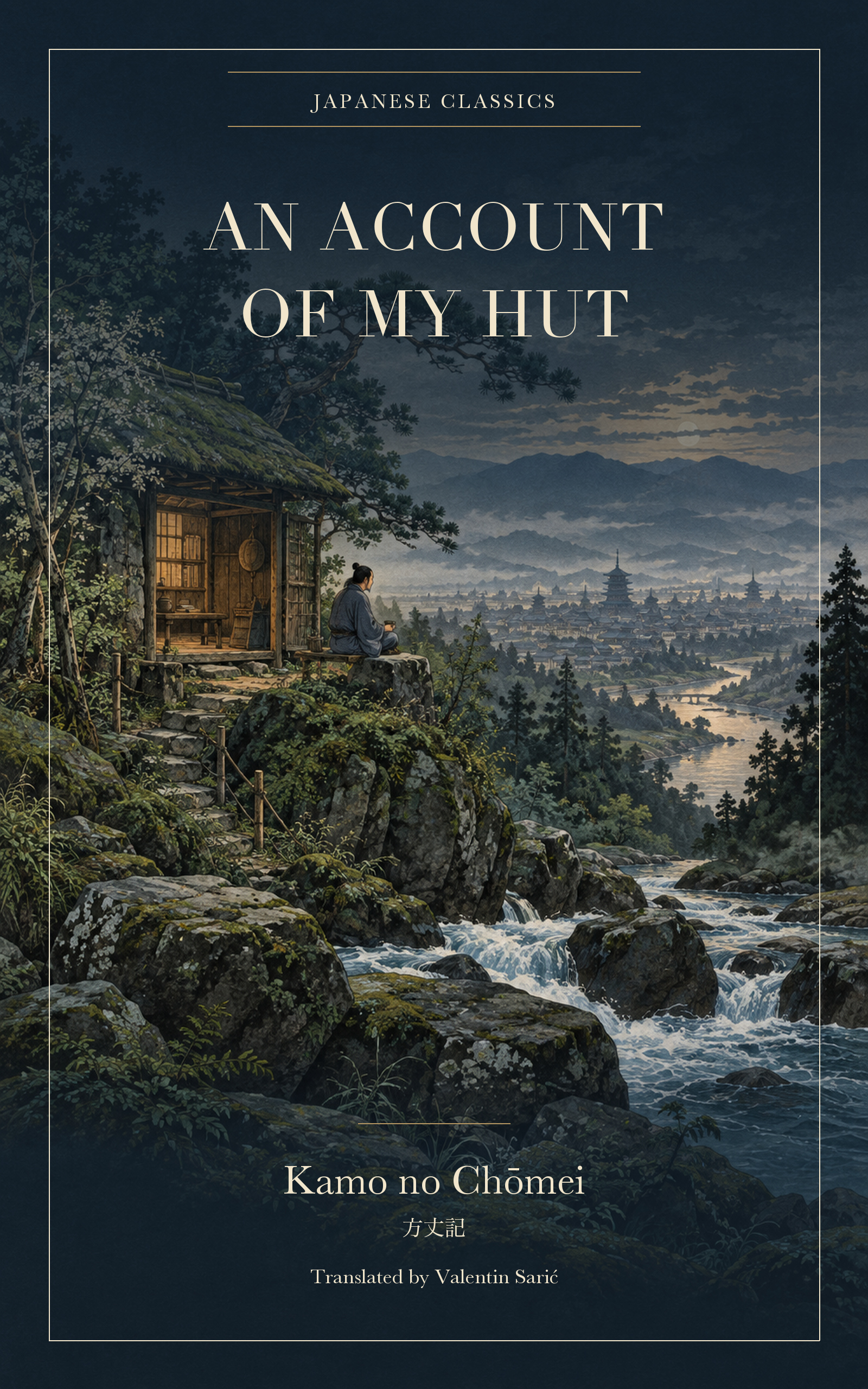
An Account of My Hut
"The flow of the passing river never ceases, and yet the water is never the water that was."
A courtier and poet who failed at court, Kamo no Chōmei withdrew in 1212 to a hut ten feet square on a mountain outside Kyoto and wrote the shortest great book in Japanese. Half of it is disaster: the fire of 1177 that ate a third of the capital, the whirlwind, the forced removal of the capital to Fukuhara, the famine in which the priests counted forty-two thousand corpses in the streets of one city, and the earthquake in which the children of a samurai family were crushed at play under a garden wall.
The other half is the hut: three metres square, taken apart and carted to a new site whenever he wishes, with a shelf of poems and music, a bracken bed, a boy from the valley for company, and the sound of the wind. And at the end, the turn that makes the book permanent — the doubt whether loving the hut is not itself one attachment too many, and whether a man who has renounced everything for the pleasure of renouncing has renounced anything at all.